Ultimate Light Box --
The Flash Diffuser System
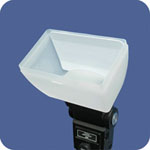 By MIKE PASINI
Editor
The Imaging Resource Digital Photography Newsletter
Review Date: April 2007
People are complicated. Take us, for example. While we froth at the mouth (both sides) whenever we discuss those little flashes tucked in tight to the lens on your typical digicam, we aren't abolitionists of artificial light. In fact, we rely on it to do about half of our product portrait photography, as we like to think of it.
Sometimes flash is the only available light.
The trick is to get the flash off the camera, far from the lens. And to bounce it. If you're working a room, you can carry the flash on a pistol grip in one hand and the camera in the other. If your focus is a single stationary object, though, you can position the flash (or three) to flatter the item and wander around it freely, confident the light won't change.
Flattering the item involves diffusing the light from the flash. Aimed directly at the subject, that bright strobe creates harsh shadows, strafing the item and bringing every flaw in to full relief.
You can diffuse the light from most flashes simply by aiming it upwards and using a rubber band to affix a business car to the back edge. You can also spend hours cutting and folding more efficient approaches. Or just bounce the light off a (white) ceiling, should you be so lucky to find a white ceiling.
But it won't be long before you start looking for a simple, small and reliable diffuser for your flash. Nikon, in fact, includes one in their SB-800 kit. It resembles one of our favorites, made by Sto-fen (http://www.stofen.com).
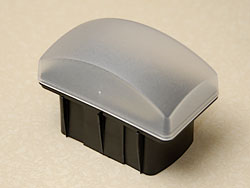
The Dome. This is the basic unit: an adapter custom designed to fit your flash and the snap-on dome (which also pops off, if you prefer).
At PMA in Las Vegas this year, we stumbled on what looked like a Sto-fen designed by NASA. It uses a custom black adapter that slips on your flash head and a particularly attractive diffuser that snapped on to that. But it doesn't stop there, much to our delight. It's actually a system of diffuser accessories that can turn your flash into a soft box, too.
We like systems. And we like soft boxes. So we asked Harbor Digital Design (http://www.harbordigitaldesign.com) to send us its Pro Pack Plus for our Nikon SB-800. The company offers less expensive packages, all of which are based on its basic domed diffuser with a custom adapter. And they all come with a money back guarantee allowing you to use the product up to 15 days before requesting a refund.
PRO PACKS | Back to Contents
The Pro Pack and Pro Pack Plus (with an additional adapter) are special introductory packages of the Ultimate Light Box System. It includes the entire Light Box System and all current accessories plus an additional Flash Adapter of your choice.
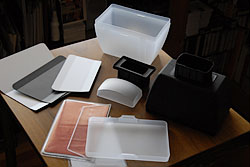
Pro Pack Plus. Includes an extra adapter over the single one supplied in the new Pro Pack.
In the compact shipping box we found:
- Flash Adapter and Small Dome. The $15.95 adapter slips over the business end of your flash. Models are available for Canon, Metz, Minolta, Olympus, Pentax, Nikon, Promaster, Sigma, Sony, Sunpak and Vivitar strobes (see the complete list). The $8.95 dome fits any of those adapters.
- Large Light Box with Lens and Diffusion Filters. The feather-weight $37.95 light box, which is 6x3.75 inches (enlarging the surface area of the flash as much as 700 percent), also fits any of those adapters and is designed to work with the small done, light box lens and the two $9.95 Lee diffusion filters (giving you three levels of diffusion).
- Large Reflector. The $9.95 V-shaped plastic reflector includes a $3.95 Velcro mounting kit but you can also just attach it directly to your flash.
- Mini Reflector. The clear $9.95 Mini Reflector bounces light that would otherwise wander off aimlessly back to the subject maintaining maximum softness. The mini Reflector mounts inside of the Light box and may be used with the large Reflector or with the Sensor Shield installed.
- Sensor Shield. The black plastic $9.95 shield blocks flash light from hitting the flash sensor when using the Ultimate Light Box in direct mode with flashes that do not have a TTL mode but do have an auto flash control mode. Works with all flash makes and models that have a sensor on the flash body.
- Black Box. The $24.95 diffuser lens creates a fill light and holds the colored filter kit.
- Colored Filter Kit. The $22.95 filter kit is a six pack of Lee color filters (red, green, blue, yellow, pink and sunlight).
- An additional Flash Adapter (Pro Pack Plus only).
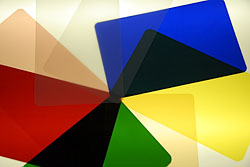
Filter Kits. Two neutral diffusers plus a set of color filters.
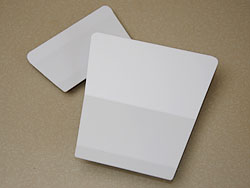
Reflectors. Two sizes come with the kit.
You may notice there's no mention of documentation. Our kit shipped with a 4.25x7 sheet titled Assembling Your Light Box Components that explained how to assemble the adapter and dome, remove the dome, mount the light box to the adapter, dissemble the light box and attach the reflector.
But current Pro Pack packages ship with new documentation that describes some basic usage setups.
A LITTLE HELP | Back to Contents
You do need a little help to understand how the adapter attaches to the light box and to the dome, too. And we found even the description included with our package adequate. And there's even more help on the company's Web site.
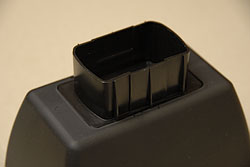
Mounted. An adapter mounted in the black box.
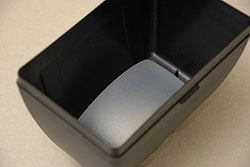
Dome in Box. Eliminates hot spots.
You remove the dome by simply slipping your fingers inside the adapter and popping the dome off from inside. And you can get the adapter off the light box by gently squeezing the longer sides of the adapter together so its little black fingers can slip inside the light box, freeing the adapter. But do that off the flash.
Options like the reflector and shield use a Velcro attachment kit to fix them to the light box. You can alternately use a rubber band to hold the reflector on your flash.
But the combinations of accessories you can configure with this setup is rather extensive. And all of them make sense in one situation or another.
Using the dome inside the light box, for example, eliminates hot spots. And adding a couple of Lee diffusion filters to the box gives you the softest light the kit can deliver. If you're losing too much light with the light box, you can attach the reflector to redirect some of it back to the subject.
But there aren't really any rules. Every combination is legal. And setup is really very quick. The pieces just pop apart and together. Configure, take a test shot, evaluation, modify the setup, test again. You actually have some control over the softness and direction of the light.
TEST SHOTS | Back to Contents
To get acquainted with the new gear, we set up a Nikon SB-800 to respond wirelessly to a D200 running its built-in flash in Commander mode. Then we set the SB-800 on its stand off to the side of our still life, a white marble statue with a black stone statue with a piece of rather exotic fruit for color against a white paper endless background.
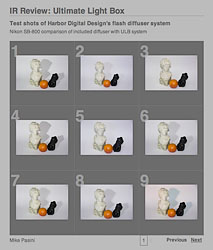
Test Shots. We tried quite a few combinations. Click on the first image to see the single-image display with captions explaining the setup.
Our first shots were three tests you can do with any SB-800: using the included diffuser aimed straight at the scene, bouncing the diffused flash off the eight-foot ceiling and bouncing undiffused flash off the ceiling (which is what we normally do).
We then attached the ULB system adapter and diffuser to the SB-800. It doesn't click on, but slides on for a firm fit.
We shot straight on and then bounced off the ceiling.
Then we attached the Light Box to the adapter and shot without the dome through the lens on the Light Box. We added a diffuser to the lens and took another shot. And finally, we shot through the dome and the lens with no diffuser.
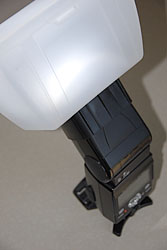
In Action. Mounted on SB-800 and firing through the dome and soft box.
Next we tried a few filters. Shooting with filters mounted to the Light Box was far too subtle for our eyes to discern an affect. The filters, in fact, are intended to be used with the Black Box. That made the difference.
We're delighted to see Lee filters employed as the colored gels because you can easily add to your collection with any of Lee's over 200 filters. You could, of course, put anything in there but with Lee filters you know what you're doing.
We shot a sequence with the Lee filters moving from green to CTO to blue to yellow to red and finally to pink.
Finally we took a shot with the large reflector attached with a nothing more than a rubber band to the SB-800 and another with the small reflector. The SB-800 includes a reflector, but it slides out from the flash head, so isn't as wide or as large as either of these reflectors.
You can see for yourself what our test shots revealed, but one thing they don't show is just how easy (not to mention fast) it was to move from one configuration to another. Having two adapters made that particularly efficient. We had one attached to the Light Box and one to the Black Box.
REAL WORLD | Back to Contents
Test shots can be revealing and are even a good way to get acquainted with new gear, but what about real world performance?
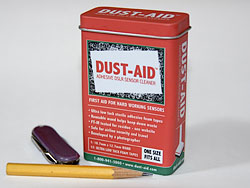
Product Shot. A soft box effect with the large white box, the cover and the dome.
A lot depends, naturally, on your strobe, particularly how powerful it is. But if it's one of the models the Ultimate Light Box supports, it's probably got all the juice you need.
We shot some product shots with the SB-800 decked out in the system. Some of these were pretty routine, but even routine product shots have their aggravations.
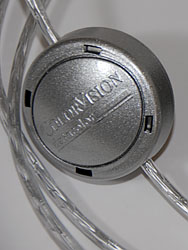
Reflective Subject. No problem. The larger the light source, the softer the light. Large white box again.
There were, for example, some products still in their retail plastic that would normally give us fits with reflections. But using the dome inside the large light box, we didn't have any hot spots. Very nice.
And when it came to illustrating an LED focus assist attachment, we were able to modulate the light enough to light the object while still showing the angle of illumination coming from the LED. That's control.
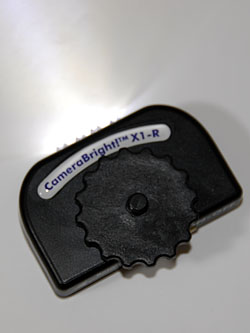
Mixed Light. The LED light still shows up with the soft light from the system.
We shot some highly reflective surfaces and got a very nice sheen. No problem.
Even ordinary setups with unremarkable props were flattered by the diffused light.
And when we mixed natural light with the strobe, it was easy to toy with the lighting ratio to balance both light sources so we could get detail in the shadows without blowing out the highlights.
In fact, we became rather glum when we realized we couldn't shoot product shots of the Ultimate Light Box System using the system itself. We had to resort to a studio flash system bouncing off the (white) ceiling. Which was safe, but not much fun.
QUIBBLES | Back to Contents
We've had to think long and hard to come up with anything remotely resembling a quibble about this system.
The only thing we could come up with is that the adapter doesn't have little bumps on the inside that snap into small indents in the side of the SB-800 flash head to secure it. How come is that, we asked.
"Our adapters are a very close tolerance press fit," President Michael J Capozzi President explained. "Our adapters are a full 1-1/4 inches deep so they fit fully on the flash. The SB-800 has a tapered head so it is necessary to press the adapter on quite firmly as full contact with the flash head is not made until the final 1/4" to 1/8" of travel. Once mounted the adapter is quite secure. Most flashes have a flash head that are flat rather than tapered so the fit on them (Canon 5780 EX, etc.) actually have a suction to them when the small dome is installed."
In fact, the adapter never did unseat itself, even though a lot of our shots were pointed down with one or the other box attached. We didn't really have to push it on, either, just snugged it on.
Not much of a quibble, admittedly, but that's the best we can do.
CONCLUSION | Back to Contents
Accessories for your accessories? Well, yes. That's one of the ways real work gets done in time to bill promptly. Which is how this sort of thing happens to pay for itself.
The Ultimate Light Box System goes a bit beyond other diffusers by offering a system of components you can quickly snap together to conjure up exactly the color, intensity and character of strobe light you want.
That makes it an excellent teacher, too. For a very modest sum you can outfit your strobe with a system that will introduce you to the basics of modulating artificial light, whether you bounce it from a reflector or fire it through a diffuser or change its color.
Outright prolonged applause!


